Prices have risen significantly in Hungary in recent years.
According to Eurostat, Hungary holds the European record for house price growth. Since 2010, property prices in the country have more than tripled (+277%), while the EU average increase during the same period was only 60.5%.
But how much do you actually have to pay for a home in Hungary today?
Of course, prices vary greatly depending on the size, quality, and location of the property, but several recent statistics offer a useful benchmark.
Analysts note that the pace of growth has slowed somewhat in recent months: annual price growth eased from 17.1% to 15.9% compared to last year — still a high rate by any standard.
Budapest
According to data from Ingatlan.com, in November 2025, the average price per square metre of resale apartments in the capital was 1.49 million forints (≈3,800 EUR). However, there are huge differences between districts.
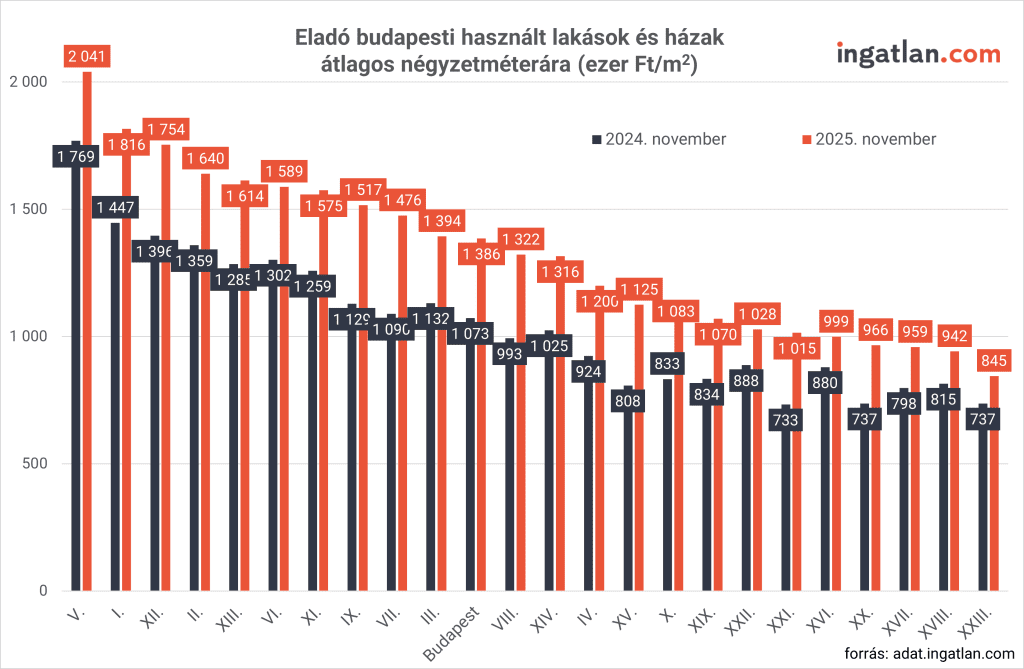
The highest prices are found in the city centre and on the Buda hills:
- District V (downtown): around 2 million HUF/m²
- District I and II (hillside areas in Buda): around 1.8 million HUF/m²
At the other end of the scale, the outskirts of the city offer properties for roughly one-third of those prices:
- District XXIII (Soroksár): around 800,000 HUF/m²
- District XVIII (Pestszentlőrinc): around 900,000 HUF/m²
Major Cities
Regional capitals also show large variations. The most expensive city is Debrecen in eastern Hungary (where a new BMW factory recently opened), with resale property prices averaging 998,000 HUF/m². In Győr (near the Austrian border) and Szeged (southern Hungary), average prices range between 900,000–950,000 HUF/m², showing that major regional industrial centres are catching up with Budapest.
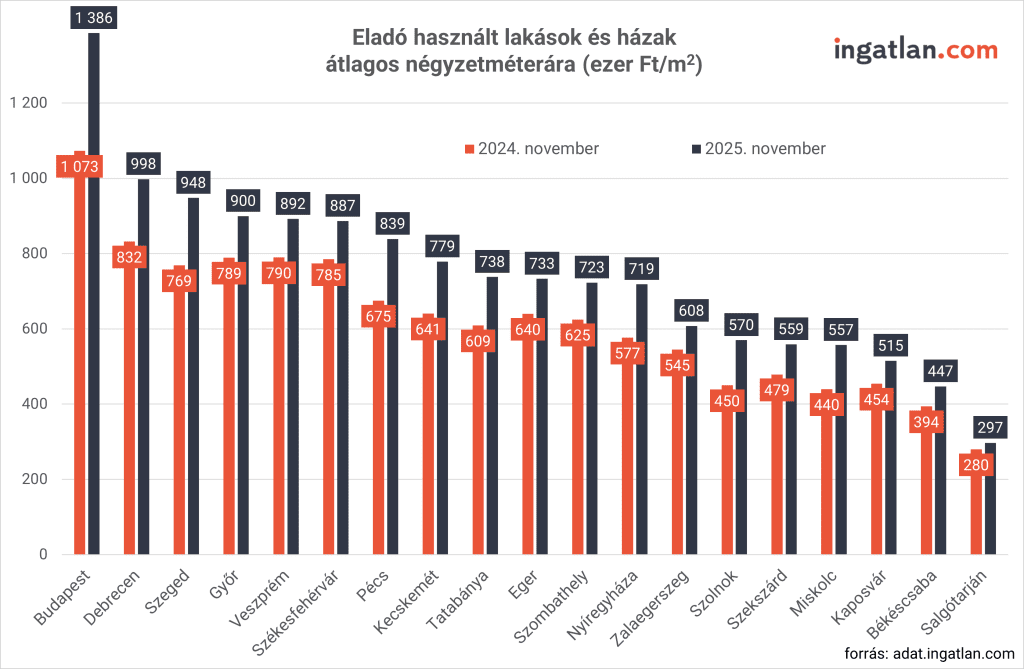
By contrast, in Salgótarján, prices average 300,000 HUF/m²; in Békéscsaba, 447,000 HUF/m²; and in Kaposvár, 515,000 HUF/m².
Panel Apartments Have Risen the Most in Price
Another study analyzed prices by property type.
According to Otthon Centrum, over the past year, the lowest increase was recorded for detached houses (+11.8%), while brick-built apartments rose 25.5%, and panel flats (prefabricated blocks built mainly during the communist era) went up by 28.2% year-on-year.
In the brick apartment category, Debrecen again leads the list, being the only major city where average prices exceed 1 million HUF/m² (1.07 million).
It is followed by Székesfehérvár (864,000 HUF/m²) and Győr (853,000 HUF/m²). Most other large cities range between 550,000 and 750,000 HUF/m².
Only smaller, more distant towns — such as Nagykanizsa (450,000 HUF/m²) or Baja (422,000 HUF/m²) — fall below that range.
The average price for panel apartments nationwide is 729,000 HUF/m². Again, Debrecen tops the list (950,000 HUF/m²), followed by Székesfehérvár (827,000) and Győr (812,000).
Among the cheapest cities are Dunaújváros (478,000), Szolnok and Miskolc (460,000), and Nagykanizsa (417,000 HUF/m²).
Most regional cities fall between 500,000–700,000 HUF/m².
Detached Houses Remain the Cheapest per Square Metre
Detached houses can still be purchased at the lowest price per square metre, with an average of 551,000 HUF/m² nationwide.
In this segment too, Debrecen leads (745,000 HUF/m²), followed by Sopron (702,000) and Győr (623,000). Not far behind are Székesfehérvár (614,000) and Érd (600,000), while most other cities range between 400,000–600,000 HUF/m².
Smaller towns farther from the capital tend to have even lower averages:
- Szekszárd: 319,000 HUF/m²
- Nagykanizsa: 333,000 HUF/m²
- Zalaegerszeg: 374,000 HUF/m²
However, it is worth noting that detached houses are usually larger, meaning the total price may not necessarily be lower — and maintenance costs, particularly for heating, are generally higher than for apartments.