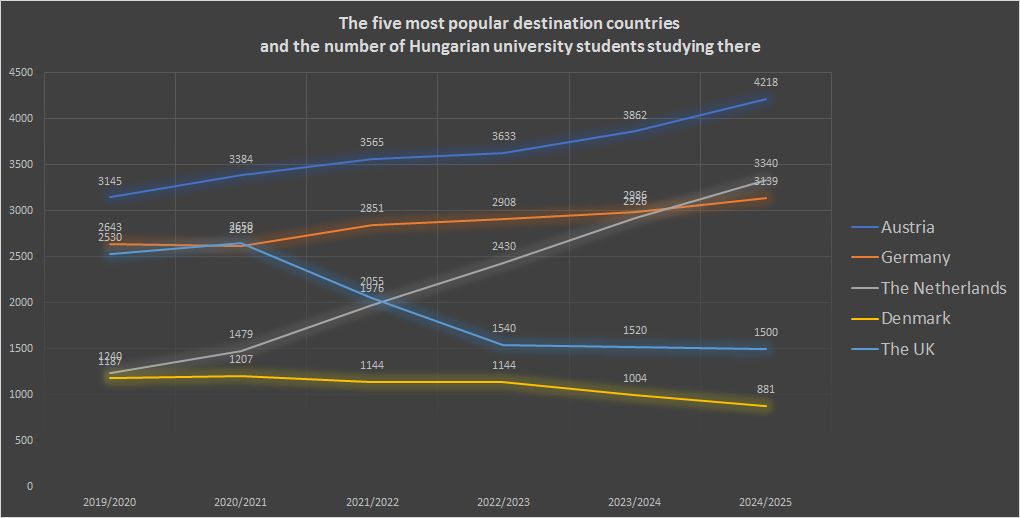
Austria remains the most popular, but the Netherlands is rapidly catching up.
“Austria continues to be the most popular destination among Hungarian students. In the 2024/25 academic year, 4,218 Hungarian students are enrolled in full-degree programmes there, which represents an increase of 356 students (9%) compared to the previous year,” reads a recent study published by Engame Academy.
Higher education is free for EU students in Austria, it is geographically close, and the admission system is stable and predictable.
Germany also remains highly popular, with 3,139 Hungarian students attending university there in the 2024/25 academic year. However, the second place on the imaginary podium does not belong to Germany but to the Netherlands, whose popularity has been rising sharply.
In the 2017/18 academic year, only 852 Hungarian students studied in the Netherlands, but today this number has jumped to 3,340—a fourfold increase. Several factors explain this trend: a wide range of English-taught programmes (which became especially important after Brexit), affordable tuition fees, and generous government support that enables students to be financially self-sufficient.
Meanwhile, Denmark’s popularity is slowly declining, and the United Kingdom’s popularity has dropped dramatically—mainly due to Brexit and extremely high tuition fees.
What are the top five destination countries for Hungarian university students?
According to experts, in addition to the countries listed above, the following destinations may become increasingly attractive for Hungarian students in the coming years: Ireland, Belgium, Sweden, Finland, Spain, Italy, Switzerland, and U.S. universities located outside the United States.
How many Hungarians study abroad today?
In the 2024/25 academic year, 18,391 Hungarian students were enrolled in full higher education programmes abroad—an all-time record. This means that one in every fourteen Hungarian university students completes their bachelor’s, master’s, or integrated degree programme abroad.
Researchers also examined the motivations of young people. Most cited the political and social climate in Hungary, the job opportunities available with a foreign degree, and the perceived quality of Hungarian higher education. In addition, about one-third mentioned a desire for adventure as a motivating factor.