The government does not help provide a clear picture—and there is a reason for that.
“Hungarian employers are highly satisfied with the work ethic and quality of work of Filipinos, which is why we must especially appreciate those Filipino men and women who have chosen Hungary as their second home, spending years here in key productive sectors and increasingly performing high value-added activities as well,” said Levente Magyar, Parliamentary State Secretary at the Ministry of Foreign Affairs and Trade, recently after attending a meeting of the Hungarian–Philippine Joint Economic Committee.
The state secretary also revealed that, relative to population size, Hungary employs the largest number of Filipino guest workers in the entire European Union, primarily in sectors where there is an insufficient supply of domestic labor.
The issue of guest workers and immigration is a very sensitive topic.
It is inherently charged with emotions—that’s simply human nature. In addition to that, about ten years ago the ruling party (Fidesz) began poisoning public discourse for political gain with anti-migrant billboards and enemy-image building disguised as a “civilizational war.”
By now, the Hungarian government—and voters along with it—have entered a state of cognitive dissonance.
- On the one hand, anti-migrant rhetoric still brings in votes.
- On the other, tens of thousands of guest workers have appeared in the meantime, who in many respects are indeed not the same as immigrants, yet in other respects are very much the same.
Today, it has become almost impossible to have a meaningful discussion about this issue in Hungary: to present facts, weigh arguments, and reach any kind of conclusion.

Few dispute that Europe needs external labor due to population decline and an aging society. In recent years, I have had the opportunity to speak with several company executives, and I have indeed formed the impression that without guest workers it would be almost impossible to keep the economy running. How individual companies make use of this double-edged opportunity is an interesting—but separate—question.
Guest workers receive the same wages as Hungarians—the debate is not really about that—but rather about the fact that they also receive benefits (such as housing) that domestic workers do not. Many see this as unfair, arguing that overall the system favors guest workers.
Based on my conversations, however, tensions have arisen more between Hungarian workers and management than between Hungarians and foreign workers.
“In recent weeks I called several factories in the city to ask about production jobs. It seemed to me that where guest workers are employed, wages are lower,” one acquaintance told me. I was unable to verify the accuracy of this claim, but I don’t find it impossible.
We rarely talk about—and I have not seen any serious analysis of—how much the presence of guest workers suppresses domestic wages. This is good for companies, but very bad for Hungarian employees.
Recently, I tried to gather more information on the topic, but ran into walls. Previously, companies were relatively forthcoming, but lately they have closed ranks—just like the authorities and institutions.
I wrote to several large companies employing guest workers. Only one replied, and only to say that they do not wish to comment on the composition of their workforce, as it constitutes a business secret. That is something I can accept.
How sensitive the issue is is also shown by the fact that state authorities and organizations do not even answer seemingly simple questions, such as how many guest workers are currently in the country, what their nationalities are, and how their numbers have changed over recent years.
This is particularly interesting because, for example, in neighboring Austria it is fully public information how many workers from which countries are employed in each province—and even in which types of jobs.
That said, several data points can be extracted from the website of Hungary’s Central Statistical Office (KSH), from which some kind of picture can be assembled:
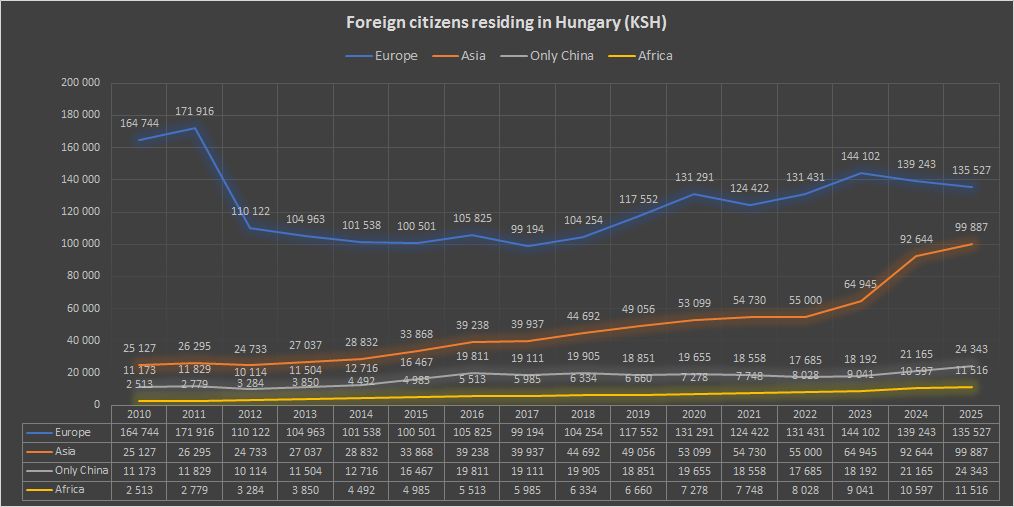
- Currently, around 255,000 foreign citizens reside in Hungary. (This figure also includes students, permanent residents, family reunification cases, etc.)
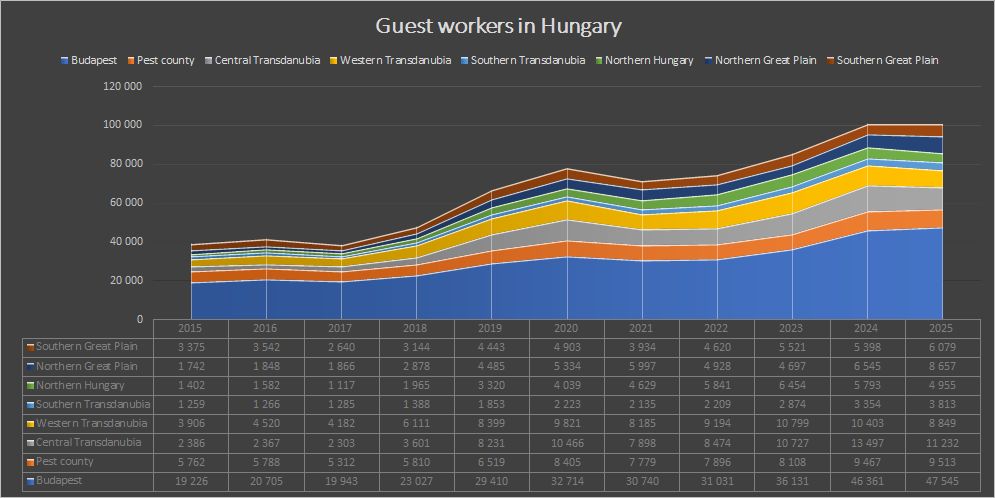
- Of these, roughly 100,000 are staying in the country “for the purpose of gainful employment” (in my interpretation: guest workers).
- The number of arrivals from Asian countries has increased sharply.
- A significant rise is also visible in the number of Africans.
- Over the course of a decade, the number of guest workers in Hungary has increased two-and-a-half times (from 39,058 to 100,643)
(A.J.)